User guide
Inventory
How to record what you own, organize it, and get it back out again.
Screenshots are from the iPhone app. The Android app has the same features, drawn in Android's own style.
Holdings
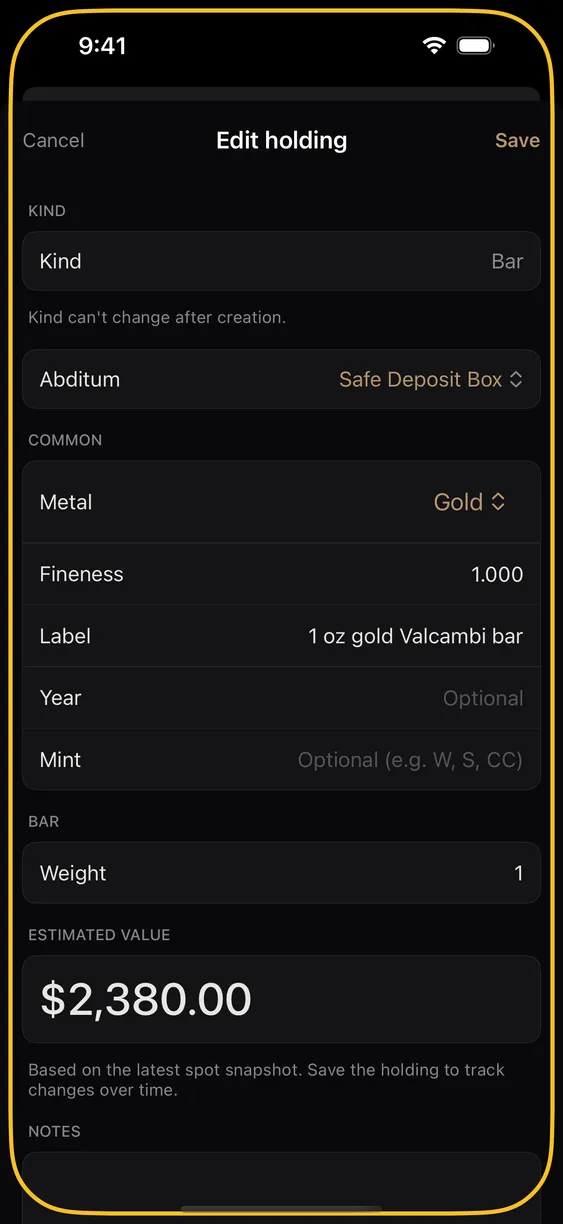
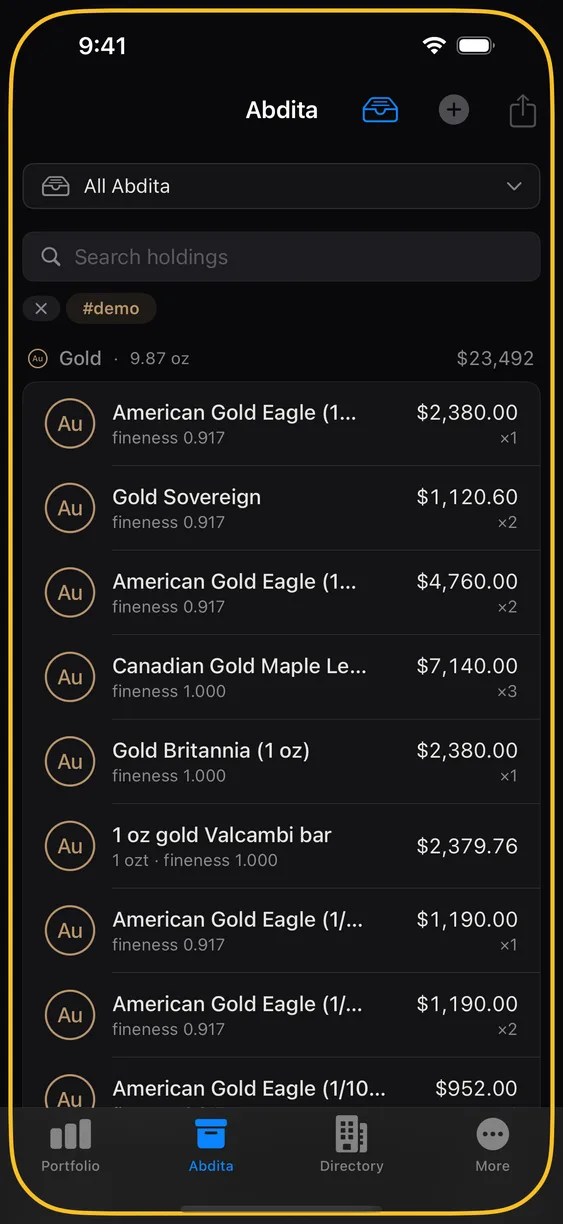
A holding is one line in your inventory: a quantity of one thing, in one place. Five metals are supported — gold, silver, platinum, palladium, and copper — in six currencies (USD, CAD, GBP, EUR, AUD, CHF), across coins, bars, rounds, junk silver, and an "other" catch-all.
Only a few fields are required: metal, kind, how many, and weight. Everything else — year, mint, purchase price, purchase date, notes — is optional, and a holding with blanks is a perfectly good holding. Fill in purchase price if you want gain and loss to mean anything; leave it out and the app simply shows current value.
There is no limit on how many holdings you can record, on any tier.
Abdita
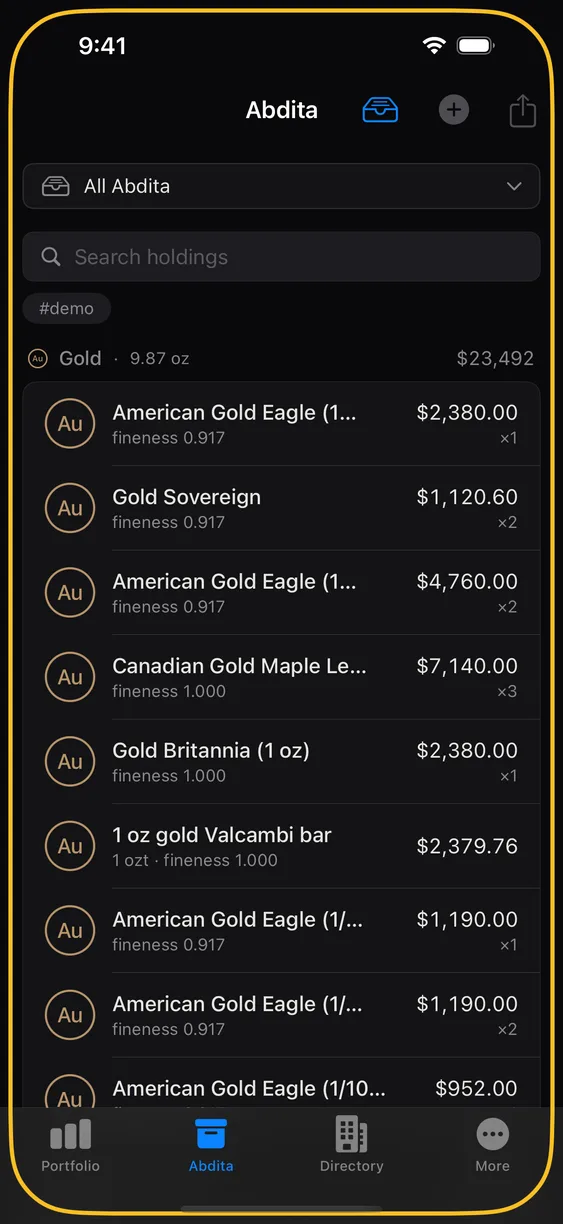
An Abditum is a container. Every holding lives in exactly one, and the name is yours to choose — most people name them for physical places: "Home safe", "Safe deposit box", "Buried in the yard". The plural is Abdita, which is the word you will see on the tab.
An Abditum can optionally record a location. That is for your record of where the container physically is; like everything else in your personal inventory, it stays on your device and is never transmitted. It is also excluded from CSV export (see below).
Abdita are the unit of sharing, too: you share an Abditum with a person, not your whole inventory. See Sharing.
Tags
Tags are free text and a holding can carry as many as you like. Where an Abditum answers "where is it?", a tag answers anything else — "gift", "pre-1965", "sell in spring", "insured". Filter by them from the Abdita tab.
Photos
Attach photos to any holding from the camera or your photo library. Two things happen at ingest, both automatically:
- Location and camera metadata are stripped. EXIF data — including GPS coordinates — is removed before the photo is stored.
- iPhone HEIC captures are converted to JPEG, so the file is portable and shows up correctly in backups and exports.
Photos on personal holdings never leave the device. Photos on a shared Abditum are encrypted on your device before upload, so the relay stores ciphertext it cannot open.
Search and filter
Search runs across product names, notes, and tags. Filters narrow by metal, by kind, and by Abditum. All of it happens on the device — no search query is ever sent anywhere.
CSV export
Export your inventory, or any filtered subset of it, as a CSV file — useful for tax prep, insurance schedules, or your own records.
What CSV does not include
Abditum names, Abditum locations, and sort order are deliberately excluded. CSV is a holdings export, not a map of where your metal is; a spreadsheet that lists both "10 oz gold bar" and "buried under the shed" is a different kind of document. If you want everything, use an encrypted backup instead.
Limits
Personal inventory does not sync between your own devices, by design — it is never transmitted, so there is nothing to sync from. Moving to a new phone is a backup and restore, not a login. See Backup & estate.